·
Kliininen dokumentaatio
Muutosloki
Klinisti
Cognitive load and end-of-shift documentation quality for nurses
How mental fatigue accumulates during nursing shifts and why end-of-shift documentation quality suffers. Evidence-based solutions for hospitals
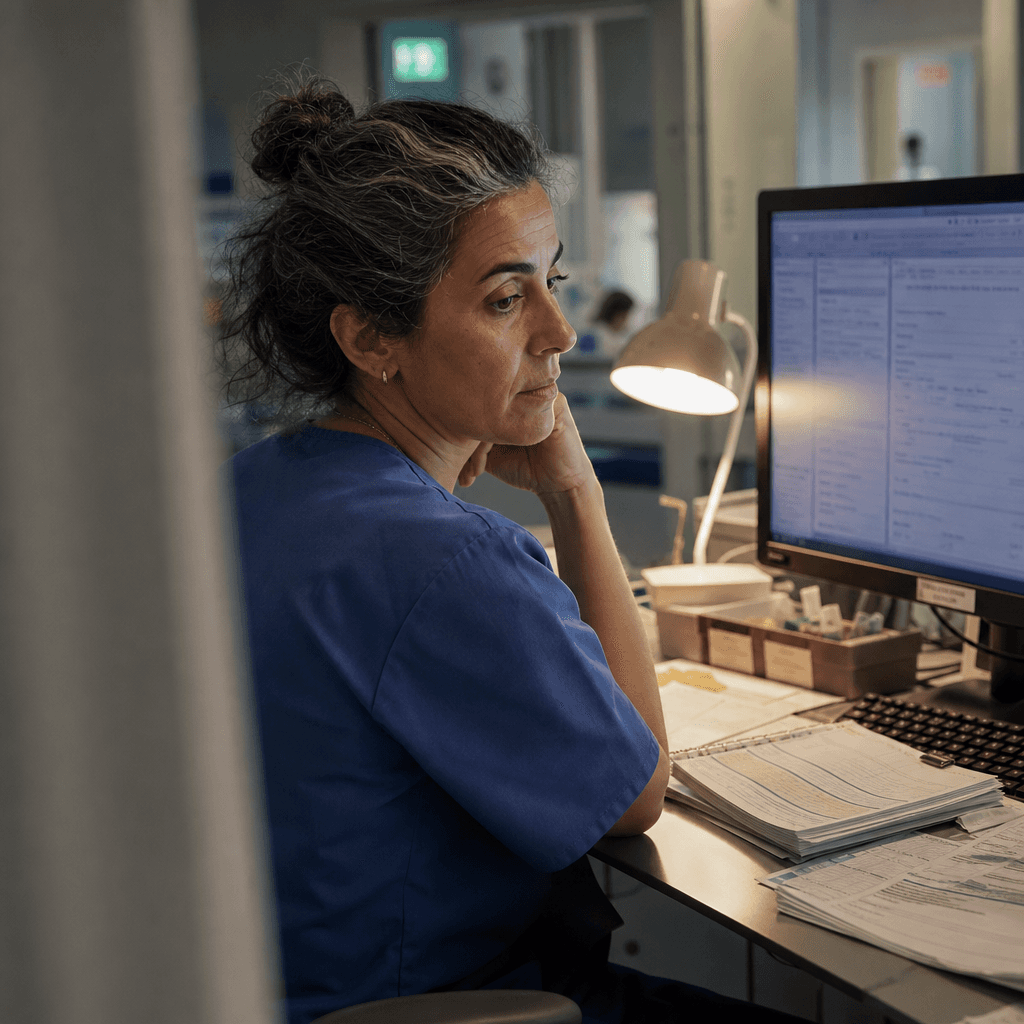
Clinical notes written at the end of a twelve-hour shift are not the same as notes written at the point of care. This is not a reflection of a nurse's skill, conscientiousness, or professional standards. It is a predictable consequence of how the human brain manages information under sustained demand. By the time the final patient has been seen and the ward has quietened enough to sit down and document, the cognitive resources required to produce accurate, complete clinical records have already been heavily drawn upon. Understanding why this happens requires looking at the mechanism, not just the outcome.
What cognitive load actually means for nurses on a shift
Cognitive load refers to the total mental effort being used at any given moment. In clinical settings, it is not a single, uniform experience. Researchers distinguish between three types that are particularly relevant to nursing practice.
Intrinsic load is the inherent complexity of the task itself: the mental effort required to assess a deteriorating patient, interpret abnormal observations, or manage a complex medication regimen. Extraneous load comes from the environment rather than the task. Interruptions, noisy ward environments, malfunctioning equipment, and poorly designed medical record system interfaces all add to this layer. Germane load is the effort devoted to learning and decision-making, forming clinical judgements, integrating new information, and updating a mental model of each patient.
All three types draw on the same finite pool of cognitive resources. As a scoping review in the Journal of Advanced Nursing confirms, when that pool is depleted through sustained high demand, interruptions, and time pressure, vigilance diminishes, decision-making quality falls, and task performance degrades. Documentation draws on the same resource as every other cognitive task a nurse performs. It doesn't sit separate from clinical thinking; it competes directly with it.
A scoping review published in International Journal of Nursing Studies reinforces this point: contextual factors such as cognitive load have a significant impact on nurses' clinical judgement and decision-making in real-world practice. These effects are often missed in vignette or survey-based research precisely because that research doesn't capture the cumulative nature of a shift.
How a typical hospital shift builds mental demand over time
A 12-hour hospital shift does not distribute cognitive demand evenly. It follows a recognisable arc, with specific periods of peak load that compound over time.
Handover is cognitively intensive from the first minute. Nurses receive dense, compressed information about multiple patients simultaneously: current status, outstanding tasks, pending results, family concerns. This information must be held in working memory while being cross-referenced against prior knowledge of each patient.
Early medication rounds add procedural complexity on top of this informational load. Each administration requires verification, calculation, and documentation, all while responding to patient requests, call bells, and requests from colleagues.
Mid-shift typically brings the highest unpredictability. Deteriorating patients, emergency admissions, and unexpected clinical events require rapid context-switching and sustained high-level decision-making. A qualitative study of intensive care unit nurses using Cognitive Load Theory and the Job Demands-Resources Model found that nurses cycle dynamically between cognitive reserve deficit, load balance, and outright cognitive overload across a shift. High alarm frequency, multitasking, and night shifts were identified as key risk factors.
The final hours arrive when fatigue has compounded accumulated load. A prospective study of 90 nurses using wearable actigraphy found a 31-point reduction in alertness on the Karolinska Sleepiness Scale (which ranges from 1 to 9) from the start to the end of a night shift, with a statistically significant association between fatigue and medication errors and near-misses. Fatigue, rather than reduced alertness alone, was the stronger predictor of errors, suggesting that cognitive depletion is the core mechanism.
This is the moment at which nurses are most commonly expected to complete their clinical documentation. Structurally, it is the worst possible time to expect high-quality, comprehensive records.
How interruptions and task-switching degrade recall
Interruptions do not simply slow nurses down. They actively damage the quality of subsequent recall. Each interruption forces the abandonment of a cognitive thread: whatever was being observed, reasoned about, or composed must be set aside. When the nurse returns to that task, reconstruction is required, and reconstruction is imperfect.
Research on emergency nursing has found that nurses in emergency settings experience frequent interruptions throughout a shift, with studies reporting interruption rates that vary by setting and context. These interruptions compound the overall cognitive load. The consequences for documentation are specific and predictable.
Details are compressed. Information observed in sequence gets collapsed into a summary that loses temporal precision. Sequencing errors occur: the order in which events happened, which is clinically relevant for understanding a patient's trajectory, becomes uncertain. Low-salience observations are dropped first. Subtle findings that did not trigger an immediate action are the most likely to be omitted, even if they are clinically meaningful in retrospect.
An integrative review of cognitive load in nursing identifies dual-tasking, interruptions, time pressure, and task complexity as the primary drivers of elevated cognitive load. All of these are standard features of a hospital shift rather than exceptional events.
The result is not that nurses document incorrectly because they are careless. It is that the conditions under which documentation occurs systematically undermine the accuracy of recall.
What gets lost: the documentation gaps most likely at end of shift
Not all clinical information is equally vulnerable to end-of-shift omission. Certain categories of documentation are consistently at higher risk.
Subtle changes in patient behaviour or affect are among the first to go. A patient who seemed quieter than usual, or who expressed anxiety that did not meet an escalation threshold, may not be recorded if it was not acted upon in the moment. The reasoning behind a clinical decision is rarely documented when time is short, leaving only the decision itself. The precise timing of observations is frequently lost: "this afternoon" is not the same as "14:20", and the difference can matter for deterioration trajectories.
Verbal exchanges with patients or families are among the first things omitted when documentation is deferred. Conversations about consent, preferences, or concerns require time to record and are easily displaced. Early signs of deterioration that did not yet meet escalation criteria are clinically significant precisely because they are subtle, and they are the most likely to be forgotten.
A cross-sectional study examining decision-making and missed care in oncology nursing found that decision fatigue and cognitive load accumulation during a shift directly affected the quality of nursing decisions and contributed to care omissions, with implications not just for what was done, but for what was recorded.
These omissions matter beyond the individual patient record. Incomplete notes compromise handover safety, create gaps in medico-legal records, and reduce the quality of information available to the next clinician, who may be making decisions based on a record that does not reflect what actually happened.
The connection between documentation burden and nurse burnout
The documentation burden and the burnout problem are not separate issues. They share the same root cause.
Nurses spend approximately 40 per cent of their shift on documentation, according to data cited by the American Association of Critical-Care Nurses. When that documentation is deferred to the end of the shift, or left incomplete, nurses face a choice with no good outcome: stay late to finish records, or leave with documentation gaps. Both carry costs. Staying late extends an already exhausting shift and erodes recovery time. Leaving with gaps creates professional risk and the persistent cognitive burden of unfinished work.
European research on shift patterns and nurse burnout, including data from the Magnet4Europe programme across 56 hospitals in Belgium, England, Germany, Ireland, Norway, and Sweden, shows that administrative load, including clinical documentation, frequently extends the effective working day beyond the paid shift. A Swiss multicentre study included in that review found patient-to-nurse ratios of 11.7 at night compared to 6.3 during the day, suggesting that documentation demands are likely greatest when cognitive resources are most depleted.
A scoping review on night shift and occupational fatigue found that chronic fatigue leads to lack of concentration, negative emotions, and decreased motivation. All of these compound the difficulty of completing complex cognitive tasks such as clinical documentation. The sense of never being fully done with administrative work is a recognised driver of emotional exhaustion in nursing. This is not a wellbeing issue that sits alongside the documentation problem. It is the same problem, experienced differently.
What European hospitals are doing to address this
European healthcare systems are approaching the documentation timing problem in different ways, reflecting significant variation in medical record system adoption rates, staffing models, and health system structure.
Point-of-care documentation, meaning recording information immediately after an observation or intervention rather than deferring it, is increasingly recognised as a structural improvement rather than a personal habit change. Wards that have redesigned workflow to include brief documentation moments throughout the shift, rather than a single end-of-shift block, report fewer omissions and more temporally accurate records.
Structured templates reduce the cognitive effort of composition. When a nurse doesn't need to decide what to write or how to structure it, the documentation task becomes faster and less demanding, freeing cognitive resources for clinical work. Standardising communication platforms has been shown to reduce cognitive load and improve documentation quality by reducing the effort required to retrieve, retain, and record information.
Mobile documentation tools allow brief, real-time capture at the bedside without requiring a nurse to return to a fixed workstation. In Northern European health systems with higher medical record system adoption rates, these tools are more widely integrated into ward workflows. In Southern European systems, where legacy infrastructure remains more common, implementation is less consistent.
Workflow redesign, specifically protecting time within the shift for documentation rather than treating it as a task to be completed after care, is among the most effective interventions. It is also among the most dependent on adequate staffing ratios. Where patient-to-nurse ratios are high, protected documentation time is difficult to sustain regardless of intent.
The evidence base for specific interventions remains uneven. Many studies are small-scale, single-site, or conducted in high-resource settings that may not generalise to under-resourced wards. Promising practices are not yet uniformly supported by large-scale controlled evidence across European health systems.
How ambient voice technology and AI assistants are changing the timing problem
Ambient Voice Technology (AVT) and AI medical assistants represent a different kind of response to the timing problem, one that addresses the structural mismatch between when clinical events happen and when they are recorded.
Rather than requiring a nurse to recall and compose a note after the fact, these tools capture clinical information at the moment it occurs. Real-time transcription converts spoken clinical observation into structured text during or immediately after an interaction, reducing the cognitive effort of documentation without requiring the nurse to stop and type. AI assistants can then generate structured notes from that captured information, further reducing the composition burden.
The practical implications are significant. A nurse who documents a patient observation verbally at the bedside, immediately after making it, produces a more accurate, more temporally precise record than one who reconstructs the same observation two hours later. The documentation is also distributed across the shift rather than accumulated at the end, reducing the peak load at the moment when cognitive capacity is lowest.
For European hospital settings, data security and compliance with the General Data Protection Regulation (GDPR) are practical procurement considerations rather than theoretical concerns. Any ambient voice tool deployed in a clinical environment must meet data residency requirements, ensuring that patient data is processed and stored within jurisdictionally appropriate boundaries, and must comply with applicable Medical Device Regulation (MDR) frameworks where AI-generated clinical content could influence care decisions. Hospitals evaluating these tools should confirm ISO 27001 certification and clear data residency commitments from any vendor. European-focused analysis of night shift documentation identifies these compliance requirements as a key factor in procurement decisions across Italian, Spanish, and other European health systems.
What better documentation timing looks like in practice
When documentation is distributed across a shift rather than deferred to the end, the character of the records changes. Notes are more temporally precise, more likely to include the reasoning behind decisions, and more likely to capture the subtle observations that are dropped under end-of-shift cognitive depletion.
The conditions that make this possible are well understood, even if they are not universally present. Adequate staffing ratios allow brief documentation moments without compromising direct patient care. Fast, accessible medical record system interfaces don't add extraneous cognitive load through poor design or slow response times. Brief structured templates take seconds rather than minutes to complete, reducing the effort of composition to the point where it can be done at the bedside. Cultural norms that treat documentation as part of care delivery rather than as administration that happens after care affect how ward teams prioritise documentation time under pressure.
Wards operating on this model exist across European health systems, particularly in settings with higher nurse-to-patient ratios and more mature digital infrastructure. The model is not aspirational in those contexts. It is operational. The challenge is extending it to settings where staffing, infrastructure, or culture have not yet aligned to support it.
Key takeaways for nurses and ward teams
The core finding of the research is straightforward: end-of-shift documentation quality is a predictable consequence of how cognitive load accumulates across a shift. It is a systems problem, and it has systems solutions. Individual nurses cannot resolve it through greater effort or diligence. The mechanisms involved are neurological, not motivational.
For nurses and ward teams looking to advocate for change or adjust what is within their control, the evidence points to several concrete directions.
Document at the point of care where possible. Even brief, immediate notes, a timestamp or a single observation, are more accurate than reconstructed records written hours later.
Use structured templates. If your medical record system uses free-text documentation by default, advocate for structured templates that reduce the cognitive effort of composition.
Name interruptions as a documentation risk. When raising concerns about documentation quality, framing interruptions as a specific mechanism rather than a general nuisance gives ward leaders something concrete to address.
Treat end-of-shift documentation pressure as a safety issue. Incomplete records at handover are a patient safety risk, not just an administrative inconvenience, and escalating this through clinical governance channels is appropriate.
Engage with technology evaluation. If your trust or health system is evaluating ambient voice or AI documentation tools, nursing input into the procurement process, particularly around workflow fit and data security, is clinically relevant, not peripheral.
The documentation burden that nurses carry at the end of a shift is not inevitable. It is the product of specific, identifiable conditions, and those conditions can be changed.
Frequently asked questions
▶ Why does cognitive load affect the quality of nursing documentation?
Cognitive load refers to the total mental effort a person uses at any given moment. In nursing, three types contribute: intrinsic load from complex clinical tasks, extraneous load from interruptions and poorly designed medical record system interfaces, and germane load from clinical decision-making. All three draw on the same finite pool of mental resources. Documentation competes directly with every other cognitive task a nurse performs, so when that pool is depleted by the end of a shift, the accuracy and completeness of clinical notes suffers as a predictable consequence.
▶ How does cognitive demand build across a 12-hour hospital shift?
Cognitive demand doesn't distribute evenly across a shift. Handover is intensive from the first minute, requiring nurses to hold dense information about multiple patients in working memory simultaneously. Early medication rounds add procedural complexity on top of that. Mid-shift typically brings the highest unpredictability, with deteriorating patients and emergency admissions requiring rapid context-switching. By the final hours, fatigue has compounded the accumulated load. A prospective study of 90 nurses found a 31-point reduction in alertness from the start to the end of a night shift, with fatigue identified as the stronger predictor of medication errors and near-misses.
▶ What types of clinical information are most likely to be missing from end-of-shift notes?
Certain categories of documentation are consistently at higher risk of omission when notes are written at the end of a shift. Subtle changes in patient behaviour or affect are among the first to go, particularly if they didn't trigger an immediate action. The reasoning behind clinical decisions is rarely recorded when time is short. Precise observation timestamps are frequently lost. Verbal exchanges with patients or families about consent, preferences, or concerns are easily deferred and then forgotten. Early signs of deterioration that didn't yet meet escalation criteria are clinically significant precisely because they're subtle, and they're the most likely to be omitted.
▶ How do interruptions damage nursing documentation quality?
Interruptions don't just slow nurses down. They actively damage the quality of subsequent recall. Each interruption forces the abandonment of a cognitive thread, and when a nurse returns to that task, reconstruction is required. Reconstruction is imperfect. Details get compressed, sequencing errors occur, and low-salience observations are dropped first. An integrative review of cognitive load in nursing identifies dual-tasking, interruptions, time pressure, and task complexity as the primary drivers of elevated cognitive load. All of these are standard features of a hospital shift, not exceptional events.
▶ What is the connection between documentation burden and nurse burnout?
Documentation burden and burnout share the same root cause. Nurses spend approximately 40 per cent of their shift on documentation, according to data cited by the American Association of Critical-Care Nurses. When documentation is deferred to the end of the shift, nurses face a choice with no good outcome: stay late to finish records, or leave with documentation gaps. Staying late extends an already exhausting shift and erodes recovery time. Leaving with gaps creates professional risk and the persistent cognitive burden of unfinished work. The sense of never being fully done with administrative work is a recognised driver of emotional exhaustion in nursing.
▶ How does ambient voice technology address the timing problem in nursing documentation?
Ambient Voice Technology (AVT) captures clinical information at the moment it occurs, rather than requiring a nurse to recall and compose a note after the fact. Real-time transcription converts spoken clinical observation into structured text during or immediately after an interaction. An AI medical assistant can then generate structured notes from that captured information. A nurse who documents a patient observation verbally at the bedside, immediately after making it, produces a more accurate and temporally precise record than one who reconstructs the same observation hours later. Documentation is also distributed across the shift rather than accumulated at the end, reducing peak load at the moment when cognitive capacity is lowest.
▶ What data security and compliance requirements apply to ambient voice tools in European hospitals?
Any ambient voice tool deployed in a clinical environment in Europe must meet General Data Protection Regulation (GDPR) data residency requirements, ensuring that patient data is processed and stored within jurisdictionally appropriate boundaries. Where AI-generated clinical content could influence care decisions, tools must also comply with applicable Medical Device Regulation (MDR) frameworks. Hospitals evaluating these tools should confirm ISO 27001 certification and clear data residency commitments from any vendor. European-focused analysis of night shift documentation identifies these compliance requirements as a key factor in procurement decisions across Italian, Spanish, and other European health systems.
▶ What practical steps can nurses and ward teams take to improve documentation quality?
The evidence points to several concrete directions. Documenting at the point of care, even a timestamp or a single observation, produces more accurate records than reconstructed notes written hours later. Structured templates reduce the cognitive effort of composition and make brief bedside documentation feasible. Framing interruptions as a specific documentation risk, rather than a general nuisance, gives ward leaders something concrete to address. End-of-shift documentation pressure is a patient safety issue, not just an administrative inconvenience, and escalating it through clinical governance channels is appropriate. Where trusts or health systems are evaluating ambient voice or AI documentation tools, nursing input into the procurement process is clinically relevant.
▶ What does better documentation timing look like in practice on a hospital ward?
When documentation is distributed across a shift rather than deferred to the end, notes are more temporally precise, more likely to include the reasoning behind decisions, and more likely to capture subtle observations that are dropped under end-of-shift cognitive depletion. The conditions that make this possible include adequate staffing ratios, fast and accessible medical record system interfaces, brief structured templates that can be completed at the bedside, and ward cultures that treat documentation as part of care delivery rather than as administration that happens after care. Wards operating on this model exist across European health systems, particularly in settings with higher nurse-to-patient ratios and more mature digital infrastructure.