How Adolphe de Rothschild Foundation Hospital gave physicians their evenings back
Hôpital Fondation Adolphe de Rothschild
Medical record system:
DxCare
Type:
Specialist care
Number of doctors:
350+
25 of 25
doctors endorsed Tandem
About Adolphe de Rothschild Foundation Hospital
Adolphe de Rothschild Foundation Hospital (HFAR) is a private non-profit hospital in Paris, founded in 1905. Today it is one of France's most specialised institutions — focused on ophthalmology, neurology, ENT, and neurosurgery — seeing 360,000 patients, performing 31,000 surgeries, and running 400 clinical trials every year. At that scale, anything that pulls clinicians away from patients has consequences.
The challenge: Documentation burden created strain in consultations
Consultations conducted at the Foundation require complex and detailed reports and documentation, frequently extended beyond clinical hours and adding administrative load to already busy days.
As Guillaume Le Hénanff, Directeur général adjoint, explained:
“Before Tandem, I would see the patient first and then stay to finalise the clinical note after the patient left.”
Clinicians divided their cognitive attention between patient interaction and documentation. This split focus created fatigue and extended working days, particularly in neurosurgery and other technical specialties.
25 doctors tested Tandem. All of them wanted to keep it.
The initiative to evaluate AI documentation was led by Guillaume Le Hénanff. Tandem was tested with 25 physicians across all specialties within the foundation.
Over a 6 week pilot, they used Tandem in more than 1,500 consultations across nearly 20 specialties.
Feedback was unanimous.
“We tested it with 25 physicians across all the specialties of the foundation, and received unanimous feedback in favour of Tandem.”
The decision to deploy was grounded in real-world clinical use rather than abstract evaluation. Physicians across departments validated the relevance of the documentation, including highly specialized terminology.
As Dr Caroline Le Guérinel, Neurosurgeon and Head of Department, noted:
“The diagnoses and terminology used in the notes generated by Tandem are already highly specialised and clinically relevant”
Tandem was integrated directly into the existing documentation workflow
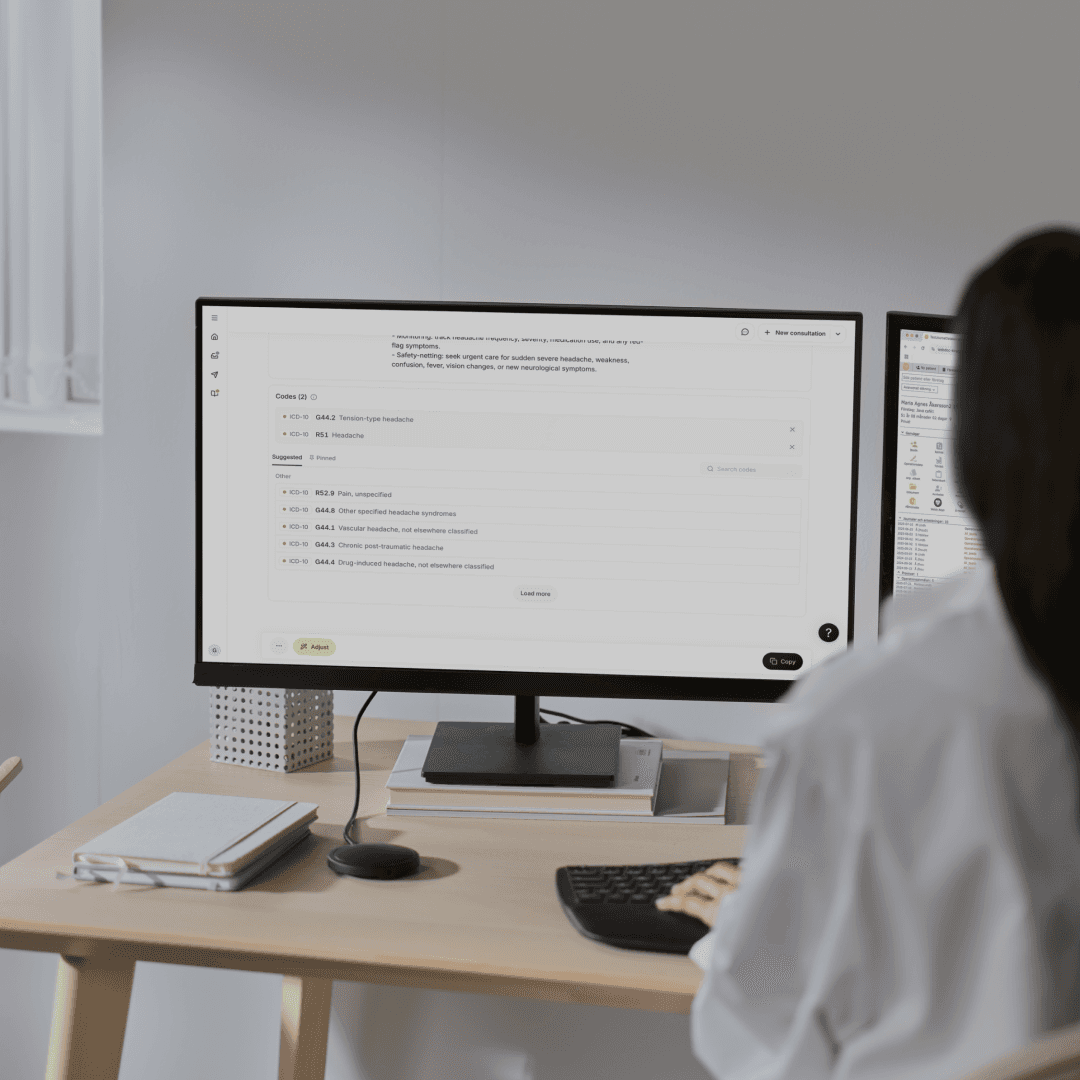
In practice, Tandem runs during the consultation. The clinician conducts the visit face to face while Tandem listens in the background.
At the end of the consultation:
A structured report is generated.
The clinician reviews and edits.
The note is finalised within the workflow.
From the clinician perspective, the change is visible in the room.
Dr. Samiya Abi Jaoudé, Neurosurgeon, described the impact:
“Tandem helps me humanise my consultation because it allows me to have a face-to-face discussion with the patient without focusing on the computer.””
She added:
“Personally, it allows me to type less, look at my computer less, and it captures the most important information from my consultation.”
Documentation shifted from a parallel task to an integrated one.
Time, fatigue, and cognitive load were reduced
Reports were completed during or immediately after consultations rather than accumulating at the end of the day. Evening documentation decreased.
Dr. Caroline Le Guérinel explained:
“Gaining time means being less tired, being less stressed in the evening, not telling yourself ‘I still have two more hours to go,’ when in fact everything is finished.”
At an institutional level, leadership saw a broader impact on physician bandwidth.
Guillaume Le Hénanff reflected:
“We’ve found an approach that enhances medical excellence during the consultation, while producing a clinical note that demands less cognitive bandwidth from the physician afterward.”
The shift reduced administrative drag inside a hospital operating at very high patient volumes.
Innovation aligned with institutional culture
The adoption of an clinical AI aligns with the Foundation’s culture of innovation.
The leadership now aims to integrate Tandem more broadly into its ecosystem, with the ambition of leveraging technological innovation to improve both the quality of patient care and follow-up, as well as the quality of working life for its healthcare professionals.