·
Töövoog ja tõhusus
Füsioteraapia ja seotud tervisealad
Praktika juhataja / Admin
Reduce physio admin burden without hiring staff
Cut physiotherapy documentation time and admin overload through workflow redesign, templates, task delegation, and AI tools. No new hires needed
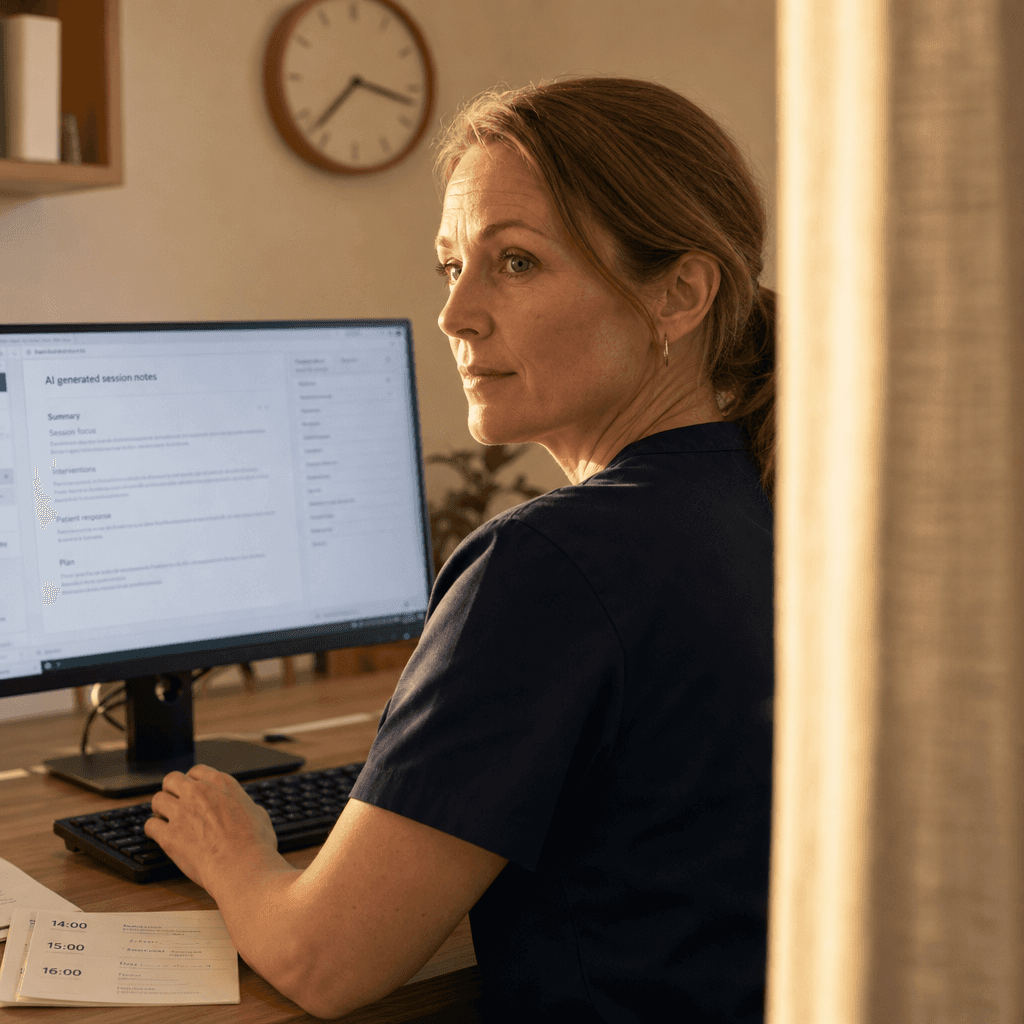
Physiotherapy clinic managers in small and medium private practices across Europe face a structural problem that rarely appears on a balance sheet but shapes almost everything about how a clinic runs. Physiotherapists see high volumes of patients, often back-to-back, and each session generates documentation, correspondence, and administrative follow-up that falls disproportionately on clinical staff. Unlike hospital settings with dedicated medical secretaries or large corporate networks with centralised admin teams, most independent physiotherapy practices have no buffer between the clinician and the paperwork. The result is that physiotherapists routinely absorb non-clinical tasks by default, not because it is the right model, but because no alternative structure exists. This article sets out what clinic managers can do, without hiring additional staff, to change that.
Why physiotherapy carries a disproportionate admin load
Among allied health professions, physiotherapy is particularly exposed to documentation and administrative pressure. A typical physiotherapist may see eight to twelve patients in a working day, each requiring a session note, progress update, and potentially a referral letter, insurance form, or patient communication. Multiply that across a week and the non-clinical output is substantial, and largely invisible to anyone calculating clinical capacity.
Administrative burden in physiotherapy is not a marginal inconvenience. Research from the American Physical Therapy Association (APTA) has found that a significant proportion of physiotherapists cite administrative burden as a contributor to burnout. The tasks most commonly implicated include prior authorisations, billing correspondence, session note completion, and insurance documentation, all of which are structurally embedded in how physiotherapy is delivered and reimbursed.
In European private practice, the problem compounds because dedicated administrative infrastructure is absent. Clinicians absorb non-clinical tasks not because those tasks require clinical expertise, but because there is no one else to absorb them. This is the starting point for any serious intervention.
The real cost of admin overload on a practice
The business case for reducing administrative burden is often framed in terms of staff wellbeing, and that framing is legitimate. But for clinic managers, the financial and operational costs are equally concrete.
Admin burden is one of the largest hidden costs in a physiotherapy business, consuming time that should go to patient care, leadership, and practice growth. When physiotherapists spend significant portions of their working day on non-clinical tasks, the immediate effects include:
Reduced appointment capacity: time spent on documentation is time not available for patient-facing work.
Increased burnout risk: chronic administrative overload is a well-documented driver of clinician exhaustion and disengagement.
Staff turnover: physiotherapists who feel overwhelmed by non-clinical demands are more likely to reduce hours or leave.
Revenue leakage: incomplete or delayed documentation can affect billing accuracy and reimbursement timelines.
Full-time clinicians in primary and community settings report working more than eleven hours per day, with over half of their administrative time spent on medical record system tasks. While that figure comes from primary care research, the pattern is consistent with what physiotherapy practice managers report anecdotally and what the APTA data confirms at scale.
The business case is straightforward: reducing admin burden increases appointment capacity, reduces turnover costs, and improves the sustainability of the practice without requiring additional headcount.
Audit first: mapping where non-clinical time goes
Before implementing any intervention, clinic managers benefit from understanding precisely where non-clinical time is being spent. Without this baseline, it is easy to invest effort in changes that address visible symptoms rather than the underlying causes.
A structured time audit does not need to be complex. Over one or two representative working weeks, physiotherapists and any existing administrative staff record how long they spend on each category of non-clinical activity. Useful categories include:
Session note writing and completion
Referral letters and correspondence
Insurance forms and prior authorisation requests
Appointment confirmations and patient reminders
Patient letters and discharge summaries
Billing queries and payment follow-up
Internal reporting and scheduling administration
The audit should distinguish between tasks that genuinely require clinical input, such as writing a referral letter or completing a clinical note, and tasks that clinicians handle only because no alternative system exists. Appointment confirmations, for example, rarely require clinical knowledge, but in many small practices the physiotherapist manages them because no one else has been assigned responsibility.
This distinction between clinician-dependent and clinician-absorbed tasks is the foundation for all subsequent redesign. Fragmented systems and manual data entry are consistently identified as primary drivers of administrative friction, and a time audit will typically reveal where those fragmentation points occur in a specific practice.
Workflow redesign: protecting clinical time through scheduling structure
Once the audit has identified where non-clinical time is going, structural changes to the working day can have an immediate impact without requiring new technology or additional staff.
The most effective workflow changes share a common principle: they separate documentation and administrative activity from patient-facing time, rather than leaving both to compete for the same unstructured slots.
Practical approaches include:
Batching documentation time: designating specific periods in the day (for example, thirty minutes mid-morning and thirty minutes at end of day) for note completion, rather than expecting physiotherapists to document between every appointment.
Buffer slots: building short gaps between appointments to allow real-time note entry rather than accumulating a backlog.
Administrative windows: scheduling defined periods for correspondence, referral letters, and insurance forms, so these tasks do not spill into clinical time or into evenings.
Reducing context-switching: grouping similar appointment types (for example, initial assessments in the morning, follow-ups in the afternoon) to reduce the cognitive overhead of switching between different documentation requirements.
Cognitive load, the mental effort required to manage competing tasks, is a real and measurable factor in clinical performance. Physiotherapists who move between patient care and administrative tasks repeatedly throughout the day carry a higher mental burden than those whose day has clear structural boundaries. Small scheduling changes can meaningfully reduce that burden without any change to staffing levels.
Workflow redesign requires clinical team buy-in to succeed. Changes imposed without consultation frequently fail or generate resistance, a point addressed in more detail in the section on common mistakes.
Documentation standardisation: templates and structured notes
One of the highest-impact, lowest-cost interventions available to clinic managers is the standardisation of clinical documentation. When physiotherapists document sessions using inconsistent formats, each note requires more cognitive effort and more time to complete than a standardised equivalent.
Pre-built physiotherapy templates within a medical record system are a practical starting point. Well-designed templates provide consistent fields that prompt clinicians to capture the relevant information quickly, without requiring them to construct a format from scratch each time.
Effective templates for physiotherapy typically include:
Presenting complaint and current functional status
Objective assessment findings (range of motion, strength, pain scores)
Treatment delivered in session
Response to treatment
Plan for next session and patient-reported goals
Any referral or correspondence required
The key design principle is that templates should be fast to complete without sacrificing clinical accuracy. Templates with too many mandatory fields, or fields that do not map to the clinical reality of a session, are often abandoned or gamed. Physiotherapists copy forward previous entries rather than completing the fields meaningfully.
Structured notes also support clinical coding (the assignment of standardised codes such as SNOMED or ICD to clinical findings), which is increasingly relevant for practices operating within integrated care systems or submitting data for insurance reimbursement. Consistent fields make it easier to extract the clinical codes required for billing and reporting, reducing the secondary administrative burden that arises when documentation is incomplete or inconsistent.
Task delegation: moving non-clinical work away from physiotherapists
A time audit will almost always reveal a category of tasks that physiotherapists handle not because those tasks require clinical expertise, but because ownership has never been clearly assigned elsewhere. These are the tasks most immediately available for delegation.
Common examples include:
Appointment confirmations and reminders: reception staff can handle these, or scheduling software can automate them.
Patient letters: standard letters (for example, confirming attendance, providing exercise programme summaries, or acknowledging discharge) can be drafted by administrative staff using templates and reviewed rather than written by the physiotherapist.
Basic insurance correspondence: trained administrative staff can handle initial requests for information or standard form completion, with clinical input only where genuinely required.
Recall reminders: automated systems can contact patients due for follow-up or review, rather than requiring clinical staff to manage the recall process manually.
A clear task ownership model, even in a small practice, specifies who is responsible for each category of administrative activity and removes the implicit assumption that the physiotherapist is the default owner. In practices where the only non-clinical staff member is a part-time receptionist, this requires explicit conversation about capacity and prioritisation, but the principle remains valid.
Centralised digital patient profiles and integrated platforms support delegation by making patient information accessible to administrative staff without requiring clinical staff to act as intermediaries for every query.
Using AI and digital tools to reduce documentation time
Ambient voice technology (AVT), which transcribes spoken clinical encounters in real time, and AI medical assistants represent the most significant recent development in clinical documentation reduction. These tools generate structured notes automatically, reducing the time required for post-session documentation from several minutes to a brief review and confirmation.
AI scribes can reduce charting time by up to 75 per cent, freeing physiotherapists for patient-facing work. For a clinician seeing ten patients per day, a reduction of even five minutes of documentation time per session represents nearly an hour of recovered clinical or rest time daily.
AI tools most relevant to physiotherapists in 2026 include:
AI medical scribes: ambient transcription tools that generate session notes from spoken consultation, requiring only review and sign-off from the clinician.
AI scheduling and follow-up systems: automated tools that reduce no-shows and manage patient communication without clinical input.
AI progress tracking: tools that generate progress summaries and outcome reports from structured data, reducing the time required for reporting and referral correspondence.
For European private practices evaluating these tools, data security and General Data Protection Regulation (GDPR) compliance are legitimate and important considerations. Clinic managers should verify that any AI documentation tool stores and processes data within the EU (data residency), holds ISO 27001 certification (an internationally recognised standard for information security management), and has a clear data processing agreement that meets GDPR requirements. These are not barriers to adoption, but they are due diligence steps that cannot be skipped.
It is also worth acknowledging a limitation in the current evidence base. While the efficiency gains from AI documentation tools are well-supported in primary care and hospital settings, the evidence base specifically for physiotherapy private practice is thinner. Clinic managers should treat published figures as directional rather than precise, and pilot any tool with a small group of clinicians before committing to full deployment.
Automation can save 38 to 47 per cent of scheduling time, approximately 700 to 870 hours per year per scheduler, according to Deloitte estimates cited in healthcare technology research. These figures relate to scheduling specifically and should not be extrapolated to clinical documentation without caution, but they illustrate the scale of efficiency available through targeted automation.
Scheduling changes that reduce hidden admin load
Beyond protecting clinical time through workflow redesign, specific scheduling strategies can reduce the volume of reactive administrative work that accumulates when patient communication is unstructured.
Automated appointment reminders are one of the most straightforward interventions available. No-show rates in physiotherapy are a significant source of wasted clinical capacity and the associated administrative burden of rebooking. Automated SMS or email reminders, sent at 48 hours and 24 hours before an appointment, consistently reduce no-show rates without requiring clinical staff involvement.
Grouping similar appointment types reduces context-switching and the associated documentation variation. A physiotherapist moving between an initial musculoskeletal assessment, a post-surgical rehabilitation session, and a sports injury review in quick succession faces different documentation requirements for each. Where scheduling allows, grouping similar appointment types reduces the cognitive overhead of switching between formats.
Building patient communication windows into the schedule, rather than leaving correspondence as unstructured overflow, prevents the accumulation of unanswered messages and incomplete referrals at the end of the day. A fifteen-minute window in the mid-afternoon, explicitly scheduled for patient communication, is more efficient than the same fifteen minutes recovered in fragments between appointments.
Automated reminders and scheduling tools are now standard features of most physiotherapy practice management systems, and their adoption in small and medium practices remains lower than the evidence base would support.
What not to do: common mistakes clinic managers make
Several interventions that appear to reduce admin burden frequently backfire in practice. Clinic managers benefit from understanding these failure modes before investing time and budget.
Introducing new digital tools without adequate training is the most common error. A new medical record system or AI documentation tool implemented without sufficient onboarding creates a short-term increase in cognitive load and a corresponding drop in staff confidence. Adoption rates fall, workarounds proliferate, and the original problem persists alongside a new one.
Adding reporting requirements in the name of efficiency is a counterintuitive but frequent mistake. Managers seeking visibility into clinical productivity sometimes introduce new data capture requirements, such as outcome measures, session counts, and treatment codes, without removing any existing requirements. The net effect is an increase in documentation burden, not a reduction.
Implementing changes without clinical team involvement consistently undermines adoption. Physiotherapists who have not been consulted on workflow changes are less likely to follow them and more likely to develop informal workarounds that reintroduce the inefficiencies the changes were designed to remove. Burnout monitoring and staff feedback loops are recommended as ongoing practices precisely because top-down implementation without feedback tends to fail.
Assuming technology will solve a process problem is a related risk. If the underlying workflow is poorly designed, automating it produces faster versions of the same errors. Process redesign should precede or accompany technology adoption, not follow it.
How to prioritise interventions when resources are limited
For clinic managers in small and medium practices where time and budget are genuinely constrained, sequencing matters. Not all interventions have equal impact-to-effort ratios, and attempting to implement multiple changes simultaneously typically results in partial adoption of all of them rather than full adoption of any.
A practical sequence for a three-to-six month implementation roadmap:
Months one and two: foundation
Complete a structured time audit to establish baseline.
Standardise session note templates within the existing medical record system.
Assign clear task ownership for non-clinical activities (appointment confirmations, patient letters, recall reminders).
Activate automated appointment reminders if not already in use.
Months three and four: workflow
Redesign the daily schedule to include batched documentation time and administrative windows.
Review scheduling patterns to reduce context-switching.
Train any administrative staff on expanded task responsibilities with clear protocols.
Months five and six: technology
Evaluate AI documentation tools against GDPR and data residency requirements.
Pilot ambient voice transcription with one or two willing clinicians.
Review outcomes against the baseline established in month one before committing to full deployment.
This sequence prioritises changes that are free or low-cost (template standardisation, task delegation, scheduling redesign) before investing in new technology. It also ensures that process foundations are in place before automation is introduced, reducing the risk of automating a poorly designed workflow.
The 'paperwork trap', characterised by fragmented systems, manual data entry, and siloed information, does not resolve itself through a single intervention. It is addressable through a structured sequence of changes that any clinic manager can begin without additional headcount, and without waiting for conditions that rarely arrive in a busy practice.
Frequently asked questions
▶ Why do physiotherapists carry a disproportionate admin burden compared to other allied health professionals?
Physiotherapists typically see eight to twelve patients per day, each requiring a session note, progress update, and potentially a referral letter, insurance form, or patient communication. In small and medium private practices, there's no dedicated administrative support to absorb these tasks, so clinicians handle them by default. Research from the American Physical Therapy Association (APTA) confirms that administrative burden, including prior authorisations, billing correspondence, and insurance documentation, is a significant contributor to physiotherapist burnout.
▶ What does admin overload actually cost a physiotherapy practice?
The costs are both operational and financial. When physiotherapists spend significant time on non-clinical tasks, appointment capacity falls, burnout risk rises, and staff turnover increases. Incomplete or delayed documentation can also affect billing accuracy and reimbursement timelines. Reducing admin burden increases appointment capacity and improves practice sustainability without requiring additional headcount.
▶ How should a clinic manager audit where non-clinical time is going?
Over one or two representative working weeks, physiotherapists and administrative staff record how long they spend on each category of non-clinical activity, including session note writing, referral letters, insurance forms, appointment confirmations, patient letters, billing queries, and scheduling administration. The key distinction to make is between tasks that genuinely require clinical input and tasks that clinicians handle only because no alternative system exists. That distinction is the foundation for any meaningful workflow redesign.
▶ What scheduling changes can reduce admin burden without hiring additional staff?
Several practical changes can help. Designating specific periods for note completion, rather than expecting physiotherapists to document between every appointment, reduces the accumulation of backlogs. Building short buffer slots between appointments allows real-time note entry. Scheduling defined windows for correspondence and referral letters prevents these tasks from spilling into clinical time. Grouping similar appointment types also reduces the cognitive overhead of switching between different documentation requirements throughout the day.
▶ How do standardised templates reduce documentation time in physiotherapy?
Pre-built templates within a medical record system provide consistent fields that prompt clinicians to capture relevant information quickly, without constructing a format from scratch each time. Effective physiotherapy templates typically include presenting complaint, objective assessment findings, treatment delivered, response to treatment, and the plan for the next session. Templates should be fast to complete without sacrificing clinical accuracy. Those with too many mandatory fields, or fields that don't reflect clinical reality, are often abandoned or completed superficially.
▶ Which administrative tasks can be delegated away from physiotherapists?
A time audit will typically reveal tasks that physiotherapists handle not because they require clinical expertise, but because ownership has never been clearly assigned elsewhere. Appointment confirmations and reminders can be handled by reception staff or automated by scheduling software. Standard patient letters can be drafted by administrative staff using templates and reviewed rather than written by the physiotherapist. Trained administrative staff can also manage initial insurance correspondence, with clinical input only where genuinely required.
▶ Can AI documentation tools reduce admin burden in physiotherapy private practice?
Ambient voice technology (AVT), which transcribes spoken clinical encounters in real time, and AI medical assistants can generate structured session notes automatically, reducing post-session documentation to a brief review and sign-off. Evidence from primary care and hospital settings suggests AI scribes can reduce charting time by up to 75 per cent. The evidence base specifically for physiotherapy private practice is thinner, so clinic managers should treat published figures as directional and pilot any tool with a small group of clinicians before committing to full deployment.
▶ What GDPR and data security checks should European physiotherapy clinics carry out before adopting AI documentation tools?
Clinic managers should verify that any AI documentation tool stores and processes data within the EU, a requirement known as data residency. The tool should also hold ISO 27001 certification, an internationally recognised standard for information security management, and have a clear data processing agreement that meets General Data Protection Regulation (GDPR) requirements. These are due diligence steps that can't be skipped, though they're not barriers to adoption.
▶ What are the most common mistakes clinic managers make when trying to reduce admin burden?
Introducing new digital tools without adequate training is the most common error, as it creates a short-term increase in cognitive load and reduces staff confidence. Adding new reporting requirements in the name of efficiency often increases documentation burden rather than reducing it. Implementing changes without consulting the clinical team consistently undermines adoption. Assuming technology will solve a process problem is a related risk: if the underlying workflow is poorly designed, automating it produces faster versions of the same errors. Process redesign should precede or accompany technology adoption.
▶ What's a practical sequence for reducing admin burden when time and budget are limited?
The article recommends a three-to-six month roadmap. In the first two months, complete a time audit, standardise session note templates, assign clear task ownership for non-clinical activities, and activate automated appointment reminders. In months three and four, redesign the daily schedule to include batched documentation time and administrative windows, and train administrative staff on expanded responsibilities. In months five and six, evaluate AI documentation tools against GDPR and data residency requirements, pilot ambient voice transcription with one or two willing clinicians, and review outcomes against the baseline before committing to full deployment.