·
Tehnoloogia omaksvõtmine
Tervishoiu
Klinitsist
Top clinical conferences to attend in Germany
Explore Germany's leading medical conferences from MEDICA to DGPPN. Essential events for European clinicians across specialties, policy and digital health
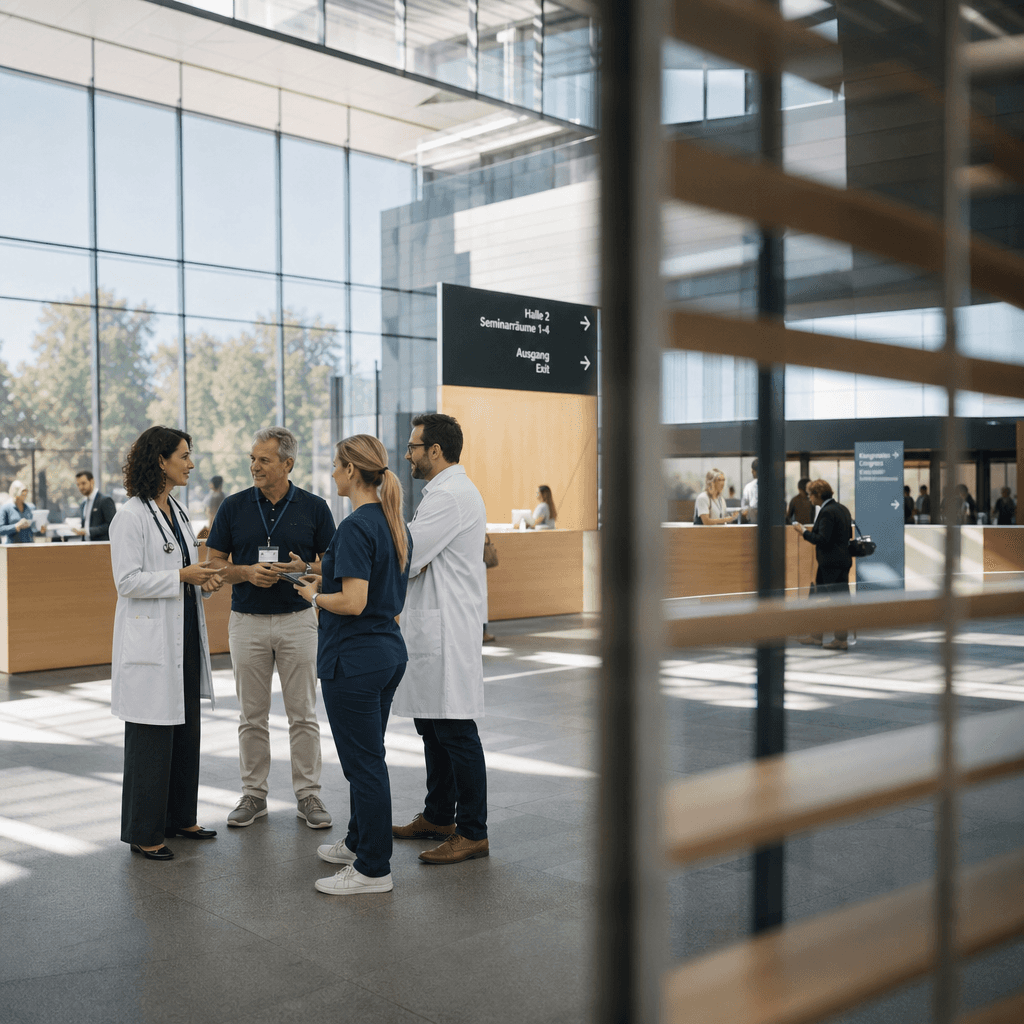
Germany sits at the centre of European medicine and is one of the continent's most active conference destinations. From large-scale medical trade fairs drawing tens of thousands of visitors to specialist society congresses shaping clinical practice across borders, the country hosts a dense calendar of professional events attracting clinicians, researchers, hospital administrators, and health technology professionals from across Europe and beyond.
Why Germany is a hub for clinical conferences in Europe
Germany operates one of the largest and most complex healthcare systems in Europe, with a statutory health insurance model covering the vast majority of its population, a dense network of university hospitals, and a long tradition of professional medical societies. The country is home to approximately 1,700–1,900 hospitals as of recent reporting years, with a research infrastructure spanning the Helmholtz Association, the Leibniz Association, and numerous academic medical centres affiliated with major universities including Charité Berlin, LMU Munich, and Heidelberg University Hospital.
This concentration of clinical expertise, industry presence, and institutional infrastructure creates natural conditions for large professional gatherings. Germany's central geographic position within the European Union also makes it logistically accessible for clinicians travelling from neighbouring countries, reinforcing its role as a meeting point for pan-European healthcare dialogue.
Professional medical societies in Germany, many of which have existed for over a century, organise annual congresses that serve as the primary continuing medical education forums for their respective specialties. These events set clinical standards, introduce updated guidelines, and provide structured platforms for peer exchange recognised across EU member states.
How these conferences were selected
The conferences listed in this article were selected based on several overlapping criteria: clinical relevance to practising healthcare professionals, scale and frequency of the event, backing by a recognised professional society or established organiser, recurrence as an annual or biennial fixture, and significance beyond Germany's borders for European healthcare audiences. Events focused primarily on commercial exhibition without substantive clinical or scientific programming were excluded. The list is not exhaustive but reflects the events most likely to be relevant to a broad range of European clinicians and healthcare professionals.
Top clinical conferences in Germany
MEDICA — World Forum for Medicine (Düsseldorf)
MEDICA is one of the world's largest medical trade fairs, held annually in Düsseldorf at Messe Düsseldorf each November. It consistently attracts more than 80,000 visitors from over 160 countries and hosts thousands of exhibitors spanning medical technology, diagnostics, digital health, laboratory equipment, and hospital infrastructure.
For clinical professionals, MEDICA's value lies not only in its exhibition floor but in its accompanying congress programme, which covers topics including point-of-care diagnostics, digital health interoperability, artificial intelligence in medicine, and hospital management. The event draws a mixed audience of clinicians, hospital administrators, health technology companies, and health system purchasers, making it one of the few venues where clinical and operational healthcare perspectives converge at scale.
MEDICA runs alongside COMPAMED, a parallel trade fair focused on medical components and manufacturing, though clinicians typically focus on the main MEDICA halls and congress sessions.
Deutscher Ärztetag (German Medical Assembly)
The Deutscher Ärztetag is the annual congress of the German Medical Association (Bundesärztekammer) and functions as the highest representative body of the medical profession in Germany. Held each spring in a rotating host city, it brings together elected physician delegates from across Germany's regional medical chambers to debate and vote on matters of medical ethics, healthcare policy, professional standards, and the future of medical education and training.
While much of the formal business is conducted in German, the Deutscher Ärztetag carries significance for European clinicians because its resolutions and position papers frequently inform national legislation and contribute to broader EU-level health policy discussions. Topics addressed in recent years have included the regulation of artificial intelligence as a medical device, physician working conditions, climate and health, and the ethics of end-of-life care.
For general practitioners, hospital doctors, and any clinician engaged in German or EU health policy, the Deutscher Ärztetag is an important event to monitor, even if attendance is primarily relevant to those working within the German system.
DGIM Annual Congress — German Society of Internal Medicine (Wiesbaden)
The DGIM Annual Congress (Deutsche Gesellschaft für Innere Medizin) is held each spring in Wiesbaden and is consistently cited as one of Europe's largest internal medicine conferences. The congress covers the full breadth of internal medicine, including cardiology, gastroenterology, nephrology, pulmonology, rheumatology, endocrinology, and oncology, making it one of the most clinically comprehensive events on the German calendar.
The congress attracts hospital physicians, subspecialists, and trainees from across Germany and neighbouring German-speaking countries. Its programme balances research presentations with practical clinical sessions and guideline updates. For secondary care clinicians working in general internal medicine or any of its subspecialties, the DGIM congress offers a rare opportunity to engage with the full scope of the discipline in a single event.
Sessions are conducted primarily in German, though selected symposia and poster sessions include English-language content, particularly those involving international speakers or multicentre trial results.
DGK Annual Meeting — German Cardiac Society (Mannheim)
The DGK Annual Meeting (Deutsche Gesellschaft für Kardiologie) is Germany's premier cardiology conference, typically held in Mannheim each spring. It covers the full spectrum of cardiovascular medicine, including interventional cardiology, heart failure, electrophysiology, imaging, and preventive cardiology, and serves as the primary continuing education event for cardiologists across the German-speaking world.
The DGK congress presents late-breaking clinical trial data, updated clinical guidelines, and structured training sessions for both established consultants and cardiology trainees. It draws cardiovascular nurses, cardiac technicians, and internists with a cardiovascular focus alongside specialist cardiologists, reflecting the multidisciplinary nature of contemporary cardiac care.
For European cardiologists unable to attend larger international events such as the ESC Congress, the DGK meeting offers a high-quality, accessible alternative with strong representation of European research.
DGHO Annual Meeting — German Society for Haematology and Medical Oncology
The DGHO Annual Meeting is the leading German-language congress for haematology and medical oncology, held each autumn in a rotating German city. It addresses cancer treatment advances, clinical trial results, haematological malignancies, supportive care, and multidisciplinary oncology team practice.
The DGHO congress integrates clinical practice with translational research, providing oncologists and haematologists with sessions that connect laboratory findings to patient management decisions. It also addresses systemic issues in cancer care, including access to novel therapies, biosimilar adoption, and the organisation of cancer centres.
Oncology nurses, palliative care professionals, and clinical pharmacists working in cancer services also attend, reflecting the congress's emphasis on team-based cancer care. The event is conducted primarily in German but frequently includes international faculty and English-language abstract sessions.
DKOU — German Congress of Orthopaedics and Traumatology (Berlin)
DKOU (Deutscher Kongress für Orthopädie und Unfallchirurgie) is Germany's largest orthopaedics and trauma surgery congress, held annually in Berlin each October. The German Society for Orthopaedics and Orthopaedic Surgery (DGOOC), the German Society for Trauma Surgery (DGU), and the Professional Association of Orthopaedics and Trauma Surgery (BVOU) jointly organise it.
The congress covers surgical techniques, implant technology, rehabilitation, sports medicine, musculoskeletal research, and trauma system organisation. It attracts orthopaedic surgeons, trauma surgeons, physiotherapists, sports medicine physicians, and rehabilitation specialists, making it one of the most interdisciplinary surgical congresses in the German calendar.
DKOU's Berlin location and October timing make it a logistically convenient event for European clinicians travelling from across the continent. Its scale, typically drawing several thousand attendees, ensures broad representation of current practice and research across the musculoskeletal specialties.
Hauptstadtkongress — Medicine and Health (Berlin)
The Hauptstadtkongress (Medicine and Health) is held annually in Berlin and occupies a distinct position in the German conference landscape. It focuses primarily on healthcare management, hospital strategy, and health policy rather than clinical subspecialty content. It brings together hospital chief executives, clinical directors, health ministry representatives, insurers, and professional society leaders to discuss the structural and organisational challenges facing the German and European healthcare systems.
Topics addressed at Hauptstadtkongress typically include hospital financing reform, workforce shortages, digitalisation strategy, integrated care models, and the governance of health system change. For clinical leaders moving into management roles, or for senior clinicians engaged in service design and health system advocacy, the congress offers a forum that is rarely replicated at specialty-specific events.
The event is conducted in German and is primarily oriented toward professionals working within or alongside the German health system, though its policy discussions frequently reflect broader European trends.
DMEA — Digital health conference (Berlin)
DMEA (formerly known as conhIT) is Europe's leading digital health and health information technology conference, held annually in Berlin. Based on previous editions, DMEA typically attracts more than 900 exhibitors, 20,000 visitors, and 470 speakers.
The conference covers medical record systems, clinical decision support (software that provides clinicians with evidence-based recommendations at the point of care), interoperability standards, telemedicine infrastructure, and artificial intelligence in clinical workflows. It is particularly relevant for clinicians with an interest in health technology adoption, for hospital IT directors and chief digital officers, and for health technology companies seeking to understand clinical requirements and regulatory expectations in the European market.
DMEA's programme includes dedicated tracks on artificial intelligence in healthcare, data governance under the General Data Protection Regulation (GDPR), and the implementation challenges associated with large-scale medical record system rollouts. These topics are increasingly central to clinical practice across all specialties. English-language content is more readily available at DMEA than at many other German clinical conferences, reflecting its international exhibitor and visitor base.
DGPPN Congress — German Association for Psychiatry, Psychotherapy and Psychosomatics (Berlin)
The DGPPN Congress is one of Europe's largest mental health conferences, held annually in Berlin each November or December. Organised by the German Association for Psychiatry, Psychotherapy and Psychosomatics, it covers the full range of mental health conditions and treatment approaches, including psychopharmacology, psychotherapy research, neuropsychiatry, psychosomatic medicine, and mental health service organisation.
The congress attracts psychiatrists, psychologists, psychotherapists, mental health nurses, social workers, and researchers. It integrates scientific research with clinical practice and health policy perspectives. Sessions address topics including the treatment of depression, schizophrenia, addiction, eating disorders, and trauma, as well as systemic questions around mental health funding, stigma reduction, and workforce development.
With tens of thousands of registered participants, the DGPPN Congress is the dominant annual event for German-speaking mental health professionals and carries significant influence over clinical guidelines and professional standards in the field.
DIVI Congress — Intensive care and emergency medicine (various cities)
The DIVI Congress (Deutsche Interdisziplinäre Vereinigung für Intensiv- und Notfallmedizin) is Germany's key annual conference for intensive care and emergency medicine, held each December in a rotating German city. The German Interdisciplinary Association for Intensive Care and Emergency Medicine organises it, covering critical care protocols, triage systems, acute care innovation, sepsis management, mechanical ventilation, and end-of-life decision-making in the intensive care unit (ICU).
The DIVI Congress draws intensivists, emergency physicians, anaesthesiologists, ICU nurses, and paramedics, reflecting the inherently multidisciplinary nature of critical care. It is one of the few German clinical conferences where nursing and medical staff engage with the same scientific programme on largely equal footing, which reflects the collaborative culture of intensive care practice.
For European clinicians working in emergency and critical care settings, the DIVI Congress offers access to German-language guideline updates and research findings that may not be readily available through English-language channels.
Emerging and specialist events worth watching
Beyond the established society congresses, a growing number of specialist conferences are gaining traction in Germany, particularly in digital medicine and artificial intelligence.
The ESMO AI and Digital Oncology Congress 2026, scheduled for 16–18 November 2026 in Berlin, brings together healthcare and digital health experts to exchange research on artificial intelligence applications in cancer care, ethical dialogue on algorithmic decision-making, and technological innovation across oncology pathways.
AiMH 2026, the 2nd International Conference on AI in Medicine and Healthcare, focuses on translating multimodal and generative artificial intelligence models into clinically meaningful solutions, addressing challenges including safety, bias, health equity, data governance, and regulatory readiness. It brings together researchers, clinicians, engineers, and policymakers in an explicitly interdisciplinary format.
The Tech Tour AI for Health 2026 event, scheduled to be held in Bochum in March 2026, will cover tracks including artificial intelligence for consultation, transcription and retrieval, diagnostics and imaging, digital clinical trials, and personalised medicine, reflecting the breadth of AI application now entering clinical workflows.
The ESPEN Congress (European Society of Clinical Nutrition and Metabolism), scheduled for Germany in September 2026, addresses clinical nutrition, metabolism, and dietetics across acute and chronic care settings.
The ECNP Congress 2026 (39th Annual), scheduled for October 2026 in Germany, focuses on neuropsychopharmacology and brain research, bridging basic neuroscience and clinical psychiatry.
These events reflect a broadening of Germany's conference portfolio beyond traditional specialty society congresses toward more interdisciplinary and technology-focused formats.
Tips for European clinicians attending German conferences
Attending conferences in Germany as a non-German-speaking European clinician is straightforward at most major events, though some practical considerations are worth noting before registering.
Language: The largest international-facing events, including MEDICA, DMEA, and the ESMO AI and Digital Oncology Congress, offer substantial English-language programming, simultaneous interpretation, or English-language materials. Specialty society congresses such as DGIM, DGK, and DGHO are conducted primarily in German, though poster sessions, international symposia, and abstract books often include English content. Clinicians with no German-language proficiency will find the most accessible events to be those with explicit international positioning.
Continuing medical education and continuing professional development recognition: Germany's professional medical chambers award continuing medical education points (Fortbildungspunkte) for accredited congress attendance, and many major events carry accreditation from the European Accreditation Council for Continuing Medical Education (EACCME). EACCME credits are recognised across EU member states and can typically be converted to national continuing professional development credits. Clinicians should verify accreditation status with the individual conference organiser before attending if credit is a primary motivation.
Selecting the right event: The German conference calendar is dense, and not every event will be relevant to every clinician. A useful starting point is to identify whether your primary interest is clinical subspecialty content, health policy and management, or digital health and technology. These three categories broadly map onto different event types: specialty society congresses serve the first, Hauptstadtkongress and similar policy forums serve the second, and DMEA and emerging AI-focused events serve the third.
Practical logistics: Major German conference cities, including Berlin, Düsseldorf, Mannheim, and Wiesbaden, are well connected by rail and air. Early registration is advisable for the largest events, as hotel availability near major conference venues can become limited several months in advance, particularly for MEDICA in Düsseldorf.
How to stay updated on German clinical conference schedules
Tracking the German clinical conference calendar requires monitoring several different types of sources, as no single aggregator covers all events comprehensively.
Professional society websites: The most reliable source for any given specialty is the website of the relevant German professional society, such as DGIM, DGK, DGHO, DGPPN, or DIVI, where congress dates, registration, and programme details are published directly.
The German Medical Association (Bundesärztekammer): The Bundesärztekammer website publishes information on the Deutscher Ärztetag and maintains links to major professional events relevant to German-registered physicians.
DMEA and MEDICA official sites: Both DMEA and MEDICA publish their dates and programme structures well in advance and maintain mailing lists for updates.
Pan-European medical calendars: Platforms such as Medflixs and AllConferenceAlert aggregate upcoming medical conferences by country and specialty, providing a useful overview of the broader landscape, though individual event details should always be verified with the official organiser.
ESMO, ECNP, and ESPEN: For European society events hosted in Germany in a given year, the respective society websites, ESMO, ECNP, and ESPEN, are the authoritative sources for programme and registration information.
One limitation worth acknowledging is that conference dates and locations for recurring events can shift between years, and some events listed in aggregator databases may be cancelled, postponed, or relocated without those databases being promptly updated. Checking directly with the organising society or official conference website before making travel or registration commitments remains the most reliable approach.
Frequently asked questions
▶ Why does Germany host so many major clinical conferences?
Germany operates one of the largest and most complex healthcare systems in Europe, with approximately 1,700–1,900 hospitals, a dense network of university hospitals, and professional medical societies that have existed for over a century. Its central geographic position within the European Union makes it logistically accessible for clinicians travelling from neighbouring countries. This concentration of clinical expertise, industry presence, and institutional infrastructure creates natural conditions for large professional gatherings.
▶ What is MEDICA and who should attend?
MEDICA is one of the world's largest medical trade fairs, held annually in Düsseldorf each November. It attracts more than 80,000 visitors from over 160 countries and covers medical technology, diagnostics, digital health, laboratory equipment, and hospital infrastructure. Its accompanying congress programme addresses topics including artificial intelligence in medicine and hospital management, making it relevant to clinicians, hospital administrators, and health technology professionals.
▶ Which German conferences are most accessible for non-German-speaking European clinicians?
MEDICA, DMEA (Europe's leading digital health and health information technology conference), and the ESMO AI and Digital Oncology Congress offer substantial English-language programming, simultaneous interpretation, or English-language materials. Specialty society congresses such as the DGIM Annual Congress and the DGK Annual Meeting are conducted primarily in German, though poster sessions, international symposia, and abstract books often include English content.
▶ Do German clinical conferences offer continuing medical education credits recognised in other EU countries?
Many major German clinical conferences carry accreditation from the European Accreditation Council for Continuing Medical Education. These credits are recognised across EU member states and can typically be converted to national continuing professional development credits. Clinicians should verify accreditation status with the individual conference organiser before attending if credit is a primary motivation.
▶ What is the DGPPN Congress and how large is it?
The DGPPN Congress is one of Europe's largest mental health conferences, held annually in Berlin each November or December. Organised by the German Association for Psychiatry, Psychotherapy and Psychosomatics, it covers psychiatry, psychotherapy, neuropsychiatry, psychosomatic medicine, and mental health service organisation. With tens of thousands of registered participants, it's the dominant annual event for German-speaking mental health professionals and carries significant influence over clinical guidelines and professional standards in the field.
▶ What does DMEA cover and why is it relevant to clinicians interested in health technology?
DMEA is Europe's leading digital health and health information technology conference, held annually in Berlin. It covers medical record systems, clinical decision support (software that provides clinicians with evidence-based recommendations at the point of care), interoperability standards, telemedicine infrastructure, and artificial intelligence in clinical workflows. Its programme includes dedicated tracks on artificial intelligence in healthcare, data governance under the General Data Protection Regulation, and the implementation challenges associated with large-scale medical record system rollouts.
▶ Which German conference focuses on healthcare management and health policy rather than clinical content?
The Hauptstadtkongress (Medicine and Health), held annually in Berlin, focuses primarily on healthcare management, hospital strategy, and health policy. It brings together hospital chief executives, clinical directors, health ministry representatives, insurers, and professional society leaders to discuss structural and organisational challenges facing the German and European healthcare systems. Topics typically include hospital financing reform, workforce shortages, digitalisation strategy, and integrated care models.
▶ What emerging conferences in Germany focus on artificial intelligence in healthcare?
Several specialist events are gaining traction in Germany in this area. The ESMO AI and Digital Oncology Congress 2026, scheduled for 16–18 November 2026 in Berlin, focuses on artificial intelligence applications in cancer care. AiMH 2026, the 2nd International Conference on AI in Medicine and Healthcare, addresses translating generative artificial intelligence models into clinically meaningful solutions. Tech Tour AI for Health 2026, scheduled for Bochum in March 2026, covers tracks including artificial intelligence for consultation, transcription, diagnostics, and personalised medicine.
▶ How can European clinicians stay updated on the German clinical conference calendar?
The most reliable sources are the websites of the relevant German professional societies, such as DGIM, DGK, DGHO, DGPPN, and DIVI, where congress dates, registration, and programme details are published directly. Platforms such as Medflixs and AllConferenceAlert aggregate upcoming medical conferences by country and specialty, though individual event details should always be verified with the official organiser. Conference dates and locations for recurring events can shift between years, so checking directly with the organising society before making travel or registration commitments is the most reliable approach.
▶ What practical tips should European clinicians know before attending a German conference?
Major German conference cities, including Berlin, Düsseldorf, Mannheim, and Wiesbaden, are well connected by rail and air. Early registration is advisable for the largest events, as hotel availability near major conference venues can become limited several months in advance, particularly for MEDICA in Düsseldorf. Clinicians with no German-language proficiency will find the most accessible events to be those with explicit international positioning, such as MEDICA and DMEA.