Tandem’s AI Scribe is the first in Europe to reach EU MDR Class IIa
Autor:
Tandem Health
·
·
Compliance
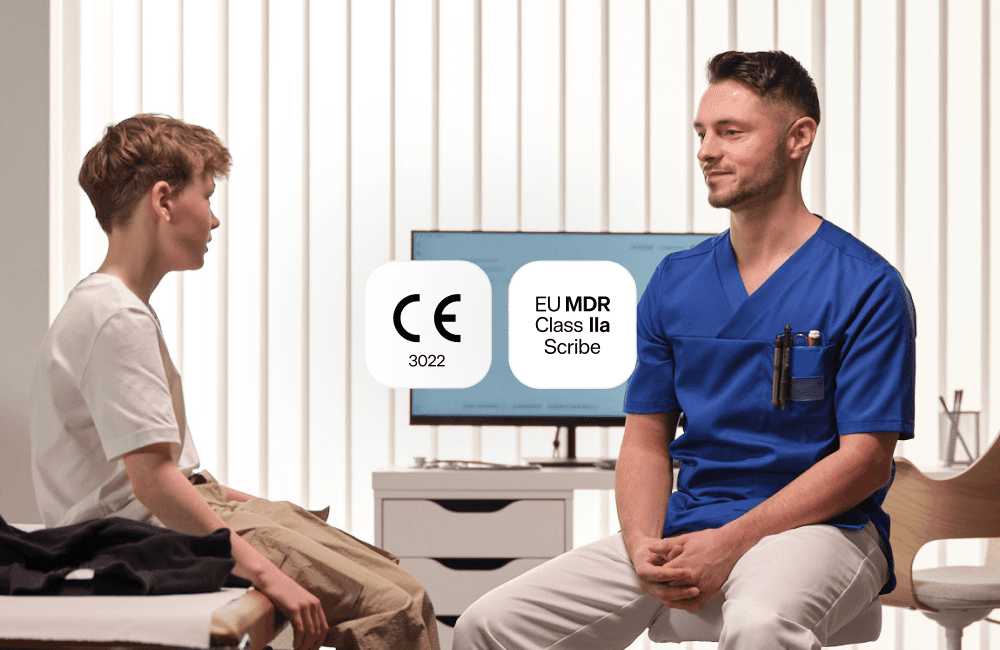
Tandem’s AI Scribe is now certified under the EU Medical Device Regulation as a Class IIa medical device, following independent notified body review and formal conformity assessment. This makes it the first AI scribe in Europe to achieve this classification.
It joins our Coding Assistant, which reached the same milestone in February 2026. Together, they form a regulated platform covering the full clinical documentation workflow: real-time note generation during the encounter and structured diagnosis and procedure codes after it, under a unified EU MDR position across Europe and the UK.
This isn’t a compliance checkbox.
It's how regulated clinical AI infrastructure gets built.
How the AI Scribe works in practice
The AI Scribe listens during the consultation, generates a structured clinical note, and transfers it directly into the patient's medical record. Nothing enters the record without clinician approval.
That note becomes the basis for future clinical decisions about that patient. It's the reason the AI Scribe falls under Class IIa, and the reason that classification is the right one.
Under EU MDR Rule 11, products that generate clinical information capable of influencing patient care are classified as Class IIa. Unlike Class I, where manufacturers self-assess, Class IIa requires an independent notified body to audit the technical, clinical, and AI-specific evidence behind the product.
Tandem completed that process. The classification is independently assessed, not self-declared.
What Class IIa means for healthcare organisations
Class IIa reduces existing uncertainty for healthcare organisations deploying AI in regulated, patient-facing environments.
It matters in three practical ways.
1. The regulatory position is clear
Procurement teams don't need to interpret classification questions internally. An independent notified body has already done that work.
2. Patient safety risk is formally controlled
The AI Scribe operates within a structured, externally assessed risk management framework, with a defined intended use and mandatory human oversight.
3. Deployment moves faster
Legal, compliance, and information governance reviews become more straightforward when the foundational work is already done. In practice, AI adoption often slows because of governance complexity, not technical performance. Class IIa removes a significant portion of that friction.
Sweden's Medical Products Agency classifies AI documentation assistants as medical devices, requiring EU MDR certification before clinical deployment. For organisations in Sweden and across Europe, this certification provides independent assurance of the product's clinical performance and safety. Pilots can start in weeks, not months.
A regulated platform for the full documentation workflow
The AI Scribe and the Coding Assistant now sit together under a unified MDR position.
That means a single regulated platform covering the entire clinical encounter: from the moment the consultation begins to the moment structured codes are transferred into the medical record.
For care organisations, this simplifies procurement. Two products, one regulatory position, independently certified at Class IIa.
For clinicians, it means the tools they use every day are built to the standards their profession requires.
What this means for Tandem
Lukas Saari, CEO and Co-founder of Tandem Health, said: “We're building Tandem to be the trusted standard for clinical AI in Europe. Class IIa certification for our AI Scribe is the next proof point that we mean it. Two certified products, one regulated platform, built for the most demanding healthcare environments in the world. This is what European clinical AI looks like.“
Tandem is used by more than 5,000 care organisations across Europe and integrates with more than 100 European medical record systems. Both the AI Medical Scribe and the Coding Assistant are CE marked under EU MDR at Class IIa.
AI in healthcare is moving from experimentation to infrastructure. Class IIa certification signals that clinical documentation support is not simply a standalone feature, but part of a regulated, quality-managed foundation for clinical workflows.
For providers, this lowers risk. For procurement teams, this removes uncertainty. For healthcare systems, this creates a clearer path from pilot to wide adoption.


