4
min read
Reduce physio admin burden without hiring staff
Cut physiotherapy documentation time and admin overload through workflow redesign, templates, task delegation, and AI tools. No new hires needed
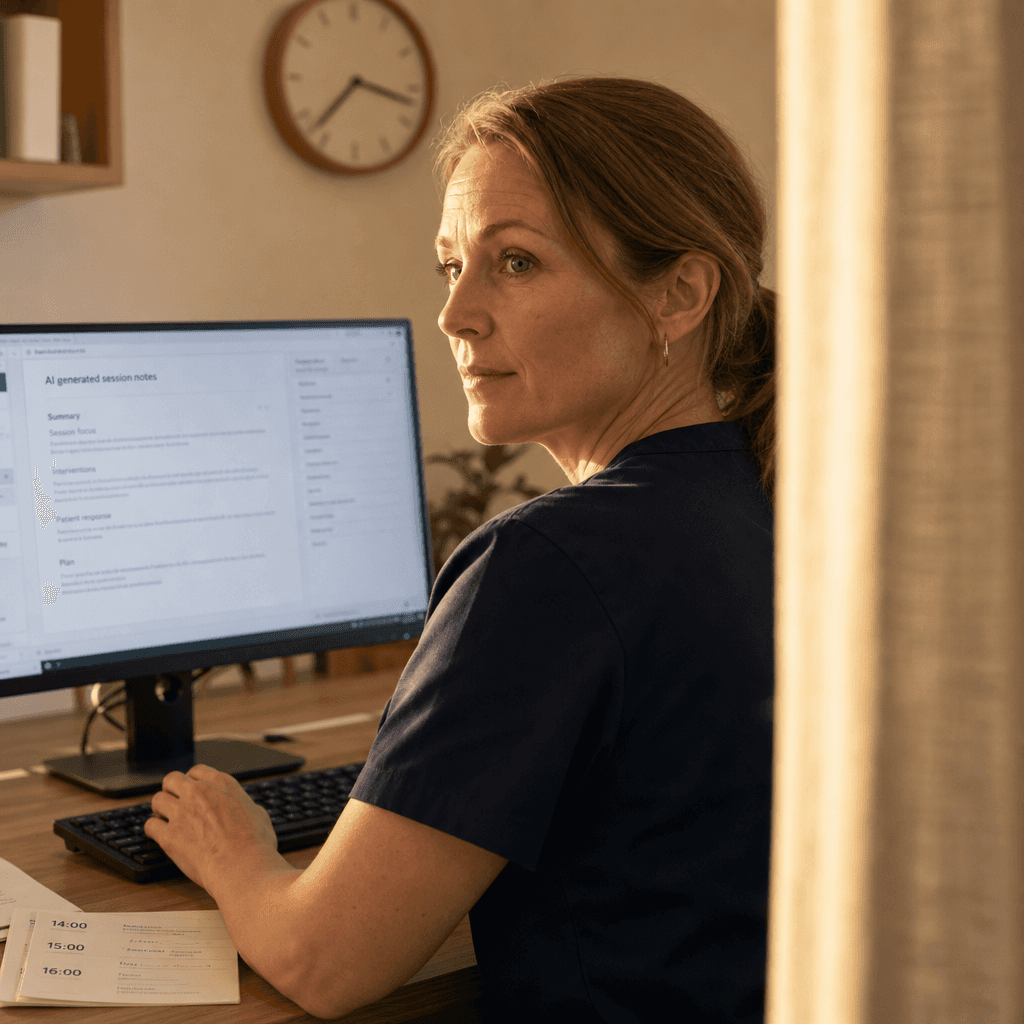
Physiotherapy clinic managers in small and medium private practices across the UK and Europe face a structural problem that rarely appears on a balance sheet but shapes almost everything about how a clinic runs. A 2025 survey of the UK physiotherapy workforce, run with the Chartered Society of Physiotherapy and published in Physiotherapy, found burnout prevalence of 49%, with 57% of respondents reporting feeling stressed "often" or "very often." Unlike hospital settings with dedicated medical secretaries, most independent practices have no buffer between the clinician and the paperwork. This article sets out what clinic managers can do about that without hiring anyone new.
Why physiotherapy carries a disproportionate admin load
A typical physiotherapist sees eight to twelve patients a day, each generating a session note, a progress update, and often a referral letter, insurance form, or patient message. The CSP's most recent commentary on the NHS Staff Survey found only 27% of physiotherapy staff feel there are enough staff to do their job safely, 40% feel unwell due to work-related stress, and 33% report burnout, up from 32% the year before. A separate qualitative study of UK physiotherapists found increased administrative demands named directly as a contributor to burnout, alongside inadequate staffing.
In private practice, the problem compounds because there's no dedicated admin infrastructure at all. Clinicians absorb non-clinical tasks not because those tasks need clinical expertise, but because there's no one else to give them to.
The real cost of admin overload
The business case isn't only about wellbeing, though that's real. When physiotherapists spend large parts of the day on non-clinical tasks, the effects are concrete: reduced appointment capacity, higher turnover risk, and revenue leakage from delayed or incomplete documentation affecting billing accuracy.
Tandem's own research into non-clinical time puts the range at 60–70% of a physiotherapist's working day going to documentation, scheduling, and admin rather than direct care, and notes that a Swiss national survey of 439 physiotherapists identified documentation-related collaboration as a significant professional challenge, particularly in community settings without hospital-level admin support. Ranges like this are more reliable than any single point estimate, since methodology varies considerably between studies.
Audit first: mapping where non-clinical time goes
Before changing anything, track where time actually goes over one or two representative weeks: session notes, referral letters, insurance forms, appointment admin, patient letters, billing queries, scheduling. The useful distinction is between tasks that genuinely need clinical input (writing a referral letter) and tasks clinicians only do because no alternative exists (appointment confirmations). That distinction is the foundation for everything else in this list.
Workflow redesign: protect clinical time with structure
Once the audit shows where time goes, scheduling changes can help immediately, without new technology or headcount:
Batch documentation time — fixed slots (say, thirty minutes mid-morning and end of day) rather than documenting reactively between every patient.
Buffer slots between appointments for real-time note entry, rather than a backlog.
Administrative windows for correspondence and forms, so they don't spill into evenings.
Group similar appointment types to cut the cognitive load of switching between different documentation formats.
Changes imposed without consulting the clinical team tend to fail or get quietly worked around, so buy-in matters as much as the design itself.
Standardise documentation: templates that actually get used
Standardising clinical documentation is one of the highest-impact, lowest-cost changes available. Effective physiotherapy templates typically cover presenting complaint, objective findings, treatment delivered, response to treatment, and plan for next session. The design principle that matters most: templates need to be fast to complete without sacrificing accuracy, or physiotherapists will copy forward previous entries rather than engaging with the fields.
Structured notes also support clinical coding, mapping findings to standardised terminology such as SNOMED CT, which NHS England has mandated across primary care since 2018. Consistent fields make it easier to extract the codes needed for billing and reporting, reducing the secondary burden that follows from incomplete documentation.
Delegate what doesn't need a clinician
A time audit almost always surfaces tasks physiotherapists handle only because ownership was never assigned elsewhere: appointment confirmations, standard patient letters, initial insurance correspondence, recall reminders. None of these need clinical judgement. A clear task ownership model, even with just a part-time receptionist, removes the default assumption that the physiotherapist picks up whatever's left over.
Using AI and digital tools to cut documentation time
Ambient voice technology and AI medical assistants are the most significant recent development here: they generate a structured note from the consultation itself, turning post-session documentation into a brief review rather than a write-up from scratch. NHS England's own guidance on ambient scribing frames this as part of the NHS's wider plan to cut administrative burden, and a 2026 survey of UK GPs found 40% were already using AI scribes.
The evidence base specific to physiotherapy is thinner than in general practice, so treat published time-saving figures as directional rather than exact, and pilot with a small group before full rollout. For data protection, verify any tool holds current ISO 27001 certification, stores and processes data within the UK or EU, and has a data processing agreement that meets UK or EU GDPR requirements. These aren't barriers to adoption — they're due diligence steps that shouldn't be skipped.
What not to do
Don't roll out new tools without training. Under-supported adoption drops confidence and creates workarounds fast.
Don't add reporting requirements without removing others. New outcome measures or codes layered on top of existing ones just increase burden.
Don't skip the clinical team. Changes made without consultation get quietly ignored.
Don't assume technology fixes a bad process. Automating a poorly designed workflow just produces faster versions of the same errors.
A realistic three-to-six month sequence
Months 1–2: Run the time audit. Standardise session note templates. Assign ownership for non-clinical tasks. Turn on automated appointment reminders.
Months 3–4: Redesign the daily schedule around batched documentation and admin windows. Train admin staff on any expanded responsibilities.
Months 5–6: Evaluate AI documentation tools against UK/EU data protection requirements, pilot with one or two willing clinicians, and check results against the month-one baseline before full deployment.
This sequence front-loads the free or low-cost changes — templates, delegation, scheduling — before any spend on technology, so the process is sound before it's automated.
Frequently asked questions
▶ How common is burnout among UK physiotherapists?
Common. A 2025 CSP-backed survey found 49% burnout prevalence and 57% reporting frequent stress. The CSP's NHS Staff Survey commentary adds that only 27% feel there's enough staff to do the job safely.
▶ Why does physiotherapy carry more admin than other specialties?
High patient volume with no buffer. Eight to twelve patients a day each generate a note, and often a letter or form, and small private practices rarely have dedicated admin staff to absorb any of it.
▶ How much of a physiotherapist's day goes to non-clinical work?
Tandem's research puts it at 60–70% of the working day, though this varies by setting and methodology, so treat it as a range rather than a fixed figure.
▶ Where should a clinic manager start?
With a time audit over one or two representative weeks, splitting tasks into those that genuinely need clinical input and those a clinician only does because no one else owns them. Everything else follows from that distinction.
▶ Can workflow changes help without buying new software?
Yes. Batching documentation into fixed slots, adding buffer time between appointments, and grouping similar appointment types all reduce admin load with no new cost, though they need clinical team buy-in to stick.
▶ Do AI documentation templates actually save time?
Only if they're fast to complete. Overloaded templates get gamed, with clinicians copying forward old entries rather than engaging with the fields. Structured notes also map more easily to SNOMED CT, which NHS England has required in primary care since 2018.
▶ What tasks can be delegated without a clinician?
Appointment confirmations, standard patient letters, initial insurance correspondence, and recall reminders. None need clinical judgement, and a part-time receptionist can usually absorb them with clear ownership assigned.
▶ What compliance checks apply before adopting an AI tool?
Confirm UK or EU data residency, current ISO 27001 certification, and a data processing agreement that meets UK GDPR requirements. These are due diligence steps, not optional extras.
▶ Is AI documentation reliable enough for physiotherapy?
Evidence is growing but thinner than in general practice. NHS England already treats ambient scribing as part of cutting admin burden, and 40% of UK GPs report using it, but physio-specific figures should be treated as directional. Pilot with a small group first.
▶ What's the biggest mistake clinic managers make?
Rolling out change without the clinical team, or adding new reporting on top of existing requirements rather than removing anything. Either one tends to increase burden rather than cut it.