One previously unrecorded diagnosis, captured per visit. A 12-week Swedish primary care pilot.
How a Swedish primary care pilot captured one previously unrecorded diagnosis per visit with Tandem, reversing a year-long decline in coding completeness.
Medical Record System:
PMO, Webdoc
Type:
Primary Care
Pilot
3 clinics + 1 control
1.5 → 2.4
previously missed diagnoses captured per visit at the lead pilot clinic
+10.2 pp
share of contacts with a diagnosis code
p<0.0001
improvement over the control clinic across 12 weeks
About the provider
A large Swedish primary care provider, operating a network of clinics in one region. The organisation has invested in structured coding-quality work through 2025, aligned with ICD-10-SE guidelines from Sweden's National Board of Health and Welfare (Socialstyrelsen).
Documentation drifted as time pressure mounted
Clinicians worked under significant time pressure. Finding the correct diagnosis code in the medical record system took time. Diagnoses sometimes went unrecorded, or got entered as unspecified Z or R codes, even when a clinical assessment had been made.
Before the pilot, the provider recorded an average of 1.5 diagnoses per contact. Through 2025, that figure had drifted down across the clinics, without the patient population becoming healthier. The team interpreted it correctly: this was a coding problem.
The cost wasn't theoretical. When diagnoses get missed in the record, the next clinician makes decisions on incomplete information. Patients fall out of digital follow-up tools for chronic disease. The picture of the population becomes wrong, and so does everything built on top of it.
A 12-week pilot, three clinics, one control
The provider ran a 12-week pilot of Tandem's Coding Assistant from January to March 2026. Three clinics took part; a fourth served as a passive reference without Tandem.
Three things mattered for the pilot decision. The Coding Assistant is CE marked Class IIa under EU MDR. Suggestions draw only on what was said in the consultation and what's already documented in the medical record system, which prevents over-coding. And every code is clinician-reviewed before it reaches the record. Clinicians stay in control.
Onboarding was light. Within four weeks, behaviour change was measurable.
Documentation completeness improved on every metric
Elsewhere, clinicians using the Coding Assistant describe a similar shift in how coding fits the day. As one gynaecology resident at another Swedish healthcare provider put it:
"With Tandem's Coding Assistant, I experienced for the first time that I save time on coding. Some visits had two-three procedure codes and two KVÅ codes and Tandem set all of them. Click, click, click, click, instead of typing them in myself."
At the lead pilot clinic, documentation completeness improved on every metric. The control clinic stayed essentially flat on diagnoses per contact and organ systems coverage, with a smaller bump on coded contacts.
Clinic A | Clinic B | Clinic C | Control | |
|---|---|---|---|---|
Diagnoses per contact | 1.56 → 2.43 (+0.86) | 2.36 → 2.60 (+0.24) | 1.93 → 2.26 (+0.33) | 2.31 → 2.35 (+0.04) |
% coded contacts | 44.6% → 54.8% (+10.2 pp) | 52.6% → 59.8% (+7.2 pp) | 50.5% → 56.3% (+5.8 pp) | 37.3% → 43.8% (+6.5 pp) |
Organ systems per contact | 1.48 → 1.90 (+0.42) | 1.80 → 2.08 (+0.28) | 1.60 → 1.85 (+0.25) | 1.83 → 1.94 (+0.11) |
The control clinic's own +6.6 pp lift on coded contacts came from the provider's wider coding-quality work through 2025. The lead clinic's gains sit on top of that, which is the additive effect of the Coding Assistant.
The effect at the lead clinic held through week 12 with no sign of decay. The probability of that improvement arising by chance is less than one in 10,000 (Fisher's combined test).
Coding happens inside the visit (not after it)
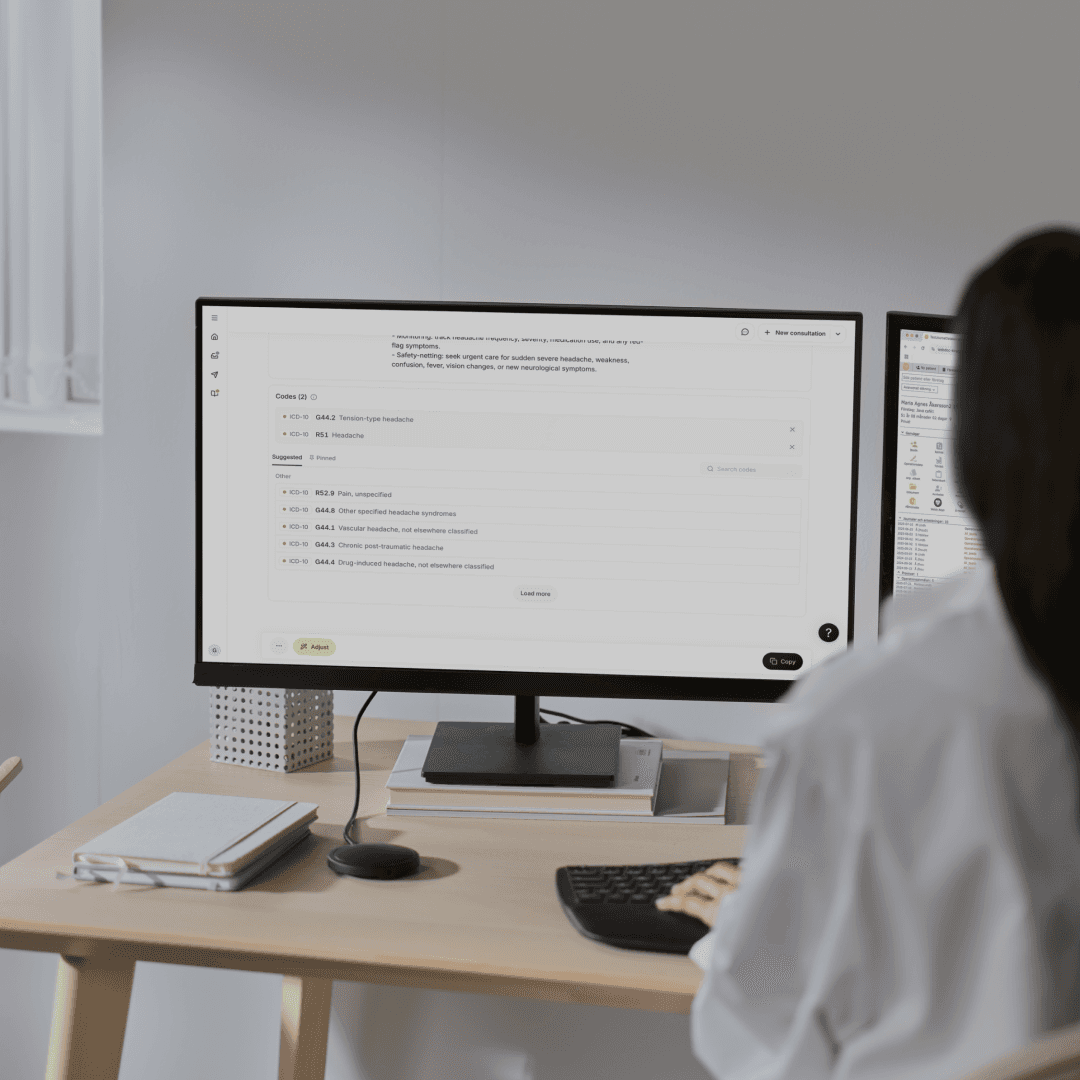
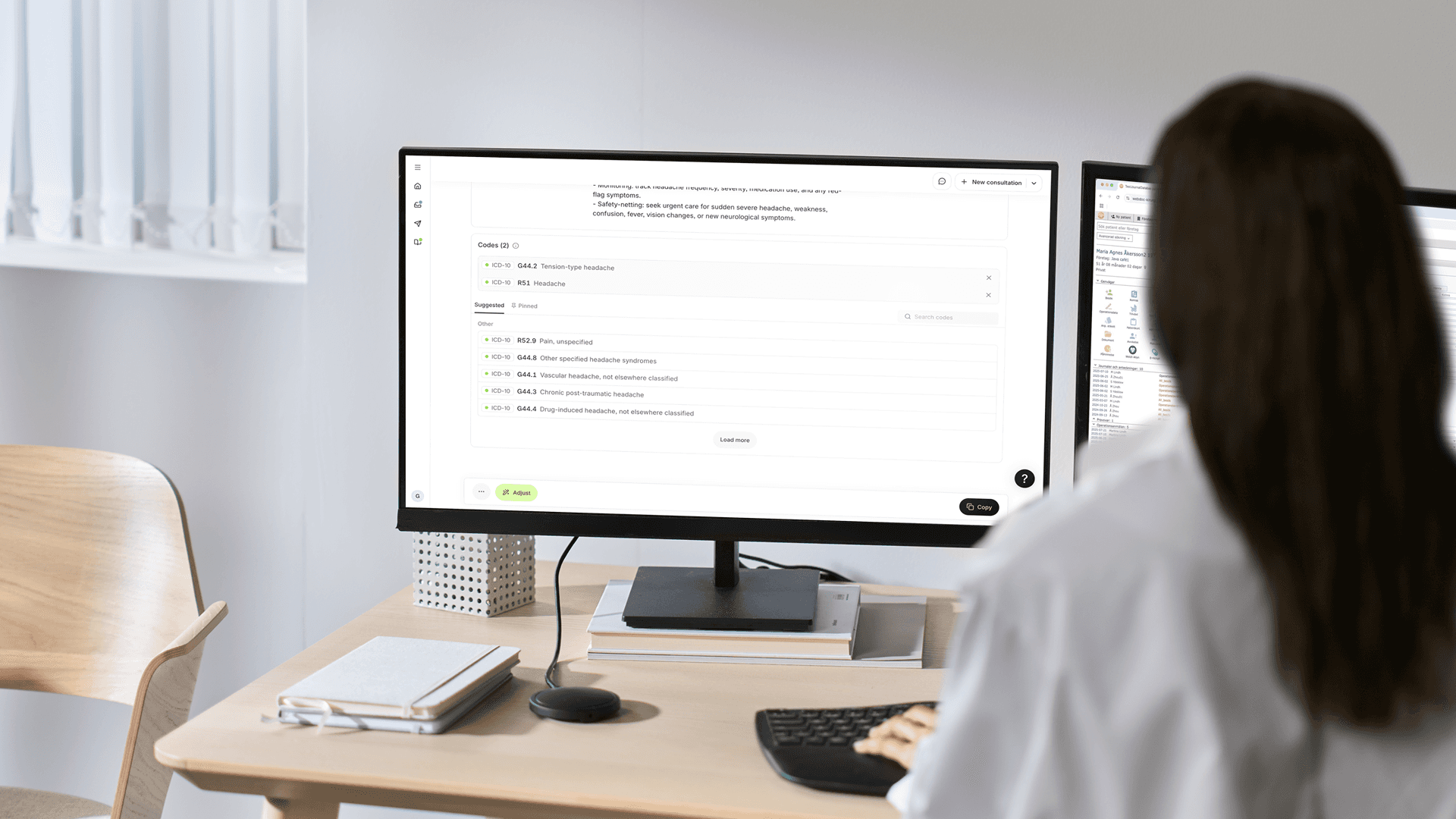
What made it work was the workflow itself. First, the Coding Assistant works inside the visit. Clinicians don't switch to a separate task afterwards. Codes surface in the same flow as documentation, while the clinical context is still fresh.
Second, every code is clinician-reviewed before it reaches the medical record. Tandem's Coding Assistant is CE marked Class IIa under EU MDR, and human oversight is part of the certification.
The product adapts to local frameworks. The Swedish clinics in this pilot used ICD-10-SE. A French clinic would use CIM-10, a German clinic ICD-10-GM. The Coding Assistant is the same in every market. Only the code sets change.
See how Tandem fits your week
Book a short demo, 30 minutes with our clinical team. We'll show you how this looks in your medical record system, on your coding framework, with your specialties.